I usually don't focus on graphics, but I'm just going to get this out of the way right now. Cryengine 2, which powers Crysis, was and is the most technically impressive game engine to date. That Crysis is still the best looking game out there three years on is a testament to the hard work Crytek put into the game, as well as to what can be achieved with PC exclusive releases. Sadly, due to pirates and some steep hardware requirements, the game wasn't the success Crytek had hoped for, so I don't expect to see any other companies going out on a limb to push the technological boundaries of PC gaming any time soon. It's a shame, but until we can get the piracy issue locked down, game sales will be unable to justify the cost of producing AAA PC exclusives outside the MMO and strategy realms. Now onto the game itself.
Much like Far Cry, the game's spiritual predecessor, the bulk of Crysis takes place on a tropical island. You play as Nomad, a U.S. military operator
who's on a mission to stop those dastardly North Koreans from whatever mischief they're up to this time. You begin the game on a plane with the rest of Raptor Team, the Nano Suit-wearing Special Forces badasses who are in charge of the mission. You're soon dropped from the plane in a spectacular parachuting sequence and land on the beach of an island in the (fictional) Lingshan Islands. The first major difference you'll notice between this and Far Cry is the Nano Suit. This piece of equipment allows the player to temporarily become invisible, run faster, become stronger, or boost their armor. It takes a little getting used to to switch to the power you want in the heat of combat, but once you get the hang of it you can toy with your enemies in much the same way the Predator toyed with Arnie and Co. back in the 80's.
After heading away from the beach and dispatching a few hostiles, the real plot of the game begins. Aztec, another member of Raptor Squad, is found dead. The thing that killed him, a flying blue octopoid creature, soon appears and snatches your team leader, Prophet, away as well, leaving just you and the Jason Statham doppleganger known as Psycho to fend for yourselves.
The gameplay for the first two-thirds of the game primarily revolves around going from enemy to base to enemy base, killing everyone in sight. Like Far Cry, you're allowed to accomplish this however you like, be it charging in guns blazing, picking them off from a distance, stealthily taking them down one by one, etc. This freedom, coupled with the power of the Nano Suit leads to some immensely satisfying gameplay, in which you can create your own action movie moments that would put Michael Bay to shame -- all totally unscripted. The AI is generally excellent, with enemies that will flank you, search you out if you try to hide, call for backup, and sound alarms. The incredible physics engine and destructible buildings also aid in the excitement. I can't tell you how awesome it is to strap a detonator to a Hummer, drive it towards a lookout tower, then simultaneously jump out of the vehicle and detonate the vehicle, which sends the tower (and the guards) crashing to the ground. It's a unique way to play a first person shooter, and more games should take note.
The aforementioned part of the game, which lasts for about four of the games eight hours, represents some of the most fun I've ever had in a video game. Sadly, after an impressive zero-g trip to an alien base in the side of a mountain, things really go downhill. Suddenly, the freedom and nonlinearity of the first part of the game are replaced with an on-rails, unexciting rescue sequence, which leads to a good hour or so of equally uninspired vehicle battles. The sudden change of rules is very jarring and frustrating, and really makes me wonder what Crytek were thinking. Fortunately, all of this culminates in an exciting and visually spectacular showdown on the deck of a ship, but it wasn't enough to wash the bad taste of the last few hours out of my mouth.
Despite this flaw, Crysis absolutely worth checking out. The first two-thirds of the game is so excellent that it still makes the overall purchase worthwhile -- and then some.
R.E.P
Tuesday, September 28, 2010

Saturday, September 25, 2010
Waaaayback Review: Trespasser (1998)
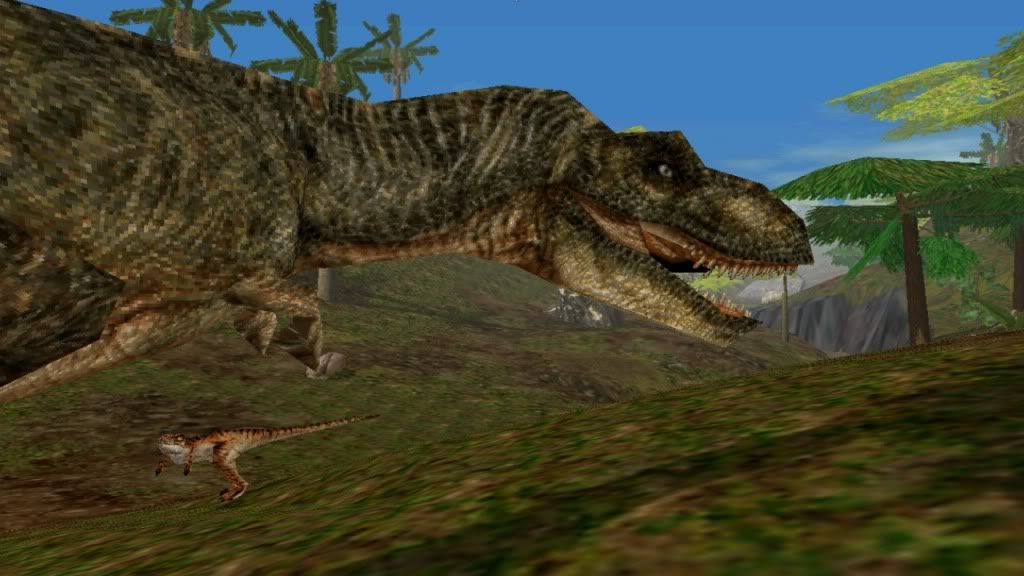
What if I told you that there was a game released in 1998 which featured fully-rendered jungle environments, dinosaurs who interacted with each other in a thriving digital ecosystem, real-time Foley sound mixing, real-time shadowing, bumpmapping, and an extremely advanced physics engine that predated (and possibly outclassed) Havok? Then what would you say if I told you the game was absolutely terrible? It should now be a little clearer why you've probably never even heard of Trespasser, the game that almost changed the world.
Trespasser is a first-person survival horror game set on Isla Sorna after the events of Jurassic Park: The Lost World. You play as Anne, a city girl with no apparent wilderness survival skills who has just found herself marooned on Isla Sorna after a nasty plane crash. There is no traditional HUD, and the only thing resembling a health meter is a heart tattoo on one of Anne's ample bosoms that slowly fills with blood as she becomes injured. Since there is no ammo counter, Anne will call off how many rounds are left as you shoot. You can't reload, so when the clip is empty you can either drop the gun or chuck it impotently at whatever carnivore happens to be baring down on you.
The first few minutes of the game were truly awe-inspiring the first time I booted the game up back in '98. The graphics were significantly better than anything else around at that time, with wonderfully rendered water that would splash and ripple convincingly when disturbed, gorgeous trees, rocks, and plant life, and (comparatively) high resolution textures. I thought I was in for one of the most amazing game experiences of my life...until I met the arm, that is.
You see, Trespasser isn't like other first person games where you walk over a gun and it instantly appears in your hands. In Trespasser, you have to push a button to extend Anne's arm, manually move the arm over to the object you want to pick up (which to Trespasser's credit is just about anything) bend down, touch her hand to it and hit the "pick up" button, then be very careful not to smack the object into anything, lest she drop it. The general idea was a great one, but the clunky implementation means it's just too frustrating to be immersive. Actually, the arm is really a microcosm of the entire Trespasser experience; everything was a great idea but nothing works. The AI, which was much touted before the game's release, was never finished and is laughably bad. Dinosaurs will run right past you, get lost, attack, then suddenly change their minds and ignore you again. The extremely "advanced" animation system doesn't work either. The dinos all look stiff, run awkwardly, and contort into bizarre shapes when they try to turn. The only promise that the developers were able to deliver on is the physics engine, which remains impressive to this day. Sadly, the barrel-and-rock-stacking physics puzzles are not up to the standard of the technology that fuels them, which ends up making the game even more frustrating.
It occurs to me that I haven't even really described Trespasser's core gameplay. Basically, it involves walking around the island from one bland physics puzzle to the next trying to find enough guns to kill the dinosaurs you aren't able to run (or rather, slowly walk) away from. There is no plot, though you will occasionally hear excerpts from John Hammond's memoirs at random, which leads me to believe there was a story at some point in development that was scrapped. The game is buggy beyond belief, so if you do decide to track down a copy, don't expect to finish the game without several patches and a lot of luck.
I must say though, that despite all of its problems, I still have a bit of a soft spot in my heart for Trespasser. It's true that the game collapsed under its own ambition, but that type of ambition is what drives the industry forward. I feel like Trespasser would have been a fantastic game if the developers had scaled back what they were trying to do with the technology and focused more on gameplay, or if the publisher had thrown them a bone and let them bring their vision to fruition, which probably would have cost a lot and delayed the game at least a year. Sadly, as it stands, it's little more than an interesting tech demo from a bygone era. Don't feel bad about skipping this one, but do have a look at the video below to see just how almost cool Trespasser was.
R.E.P
Waaaayback Review: Quake (1996)
Since we at Headshot play lots of older titles, and since we're a fairly new blog lacking a large backlog of reviews, we will occasionally be revisiting older games.

By 1996 it was pretty much a given that id Software were the kings of the first person shooter. Not only had they pioneered the genre with Wolfenstein 3D, they followed it with a little game called DOOM, the standard to which all FPS games were held for years. However, as good as both those games were (and are) neither one can hold a candle to the game that remains id's masterpiece after all these years: Quake.
At first glance Quake appears to just be a Doom clone with prettier graphics, but looks can be deceiving. In reality, Quake took everything we loved about Doom and refined it to perfection. The levels are excellently designed and fun to navigate. The world is oppressively dark and Lovecraftian, much moreso than in Doom. The movement mechanics just feel right. But most importantly, the enemies are absolutely WONDERFUL. Few games before or since have offered enemies that require such a constant shift in gameplay style. Each creature requires its own strategy to beat, and when you get several of these different monsters in a room at the same time, the game reaches something like FPS sublimity. Take the ogre, for example. This beast has a chainsaw arm, so the natural inclination upon first meeting him is to fight from a distance...until you find out he also has a grenade launcher. Battling him now becomes a juggling act of dodging his grenades while you spray him with bullets while trying to keep a safe distance from his chainsaw. That is until you start meeting them on narrow catwalks where dodging becomes impossible, which forces you to take a whole new strategy. Now imagine combining that experience with five or six other equally challenging monstrosities. Quake really knows how to keep you on your toes.
As far as level design goes, the lack of variety (and non-brown colors) has been a major turn-off for a lot people. I don't really see why. Each level is very short, and the entire game should only take a few hours to beat, so the fact that it all takes place in unspeakably blasphemous castles and eldritch caverns didn't really bother me. The game is just too brief to ever wear out its welcome.
Another thing that made Quake legendary is, of course, its multiplayer mode. This is the game that more or less started it all, kids. It wasn't the first FPS that allowed players to do their massacring online, but it was undoubtedly the most successful. Ever hear some idiot try to dismiss a game as being a "twitch shooter," as though the fact that it's fast paced somehow makes it bad? Well, Quake is the main reason that term even exists. The new (at the time) control schemes allowed it to be fast-paced in a way that Doom never was, and it defined an era of gameplay style that dominated the genre for nearly a decade. Oh, and it was really, really fun.
The main question on a lot of people's minds when reviewing an older game is obviously, "Has it stood the test of time?" With Quake, I think the answer to that question depends on what kind of gamer you are. Sadly, many gamers tend to focus on technology over the fun factor, and those people will probably be let down by Quake. It isn't Modern Warfare 2. It doesn't have shiny graphics or cool special effects, and it doesn't hold your hand and tell you exactly what to do at every turn (though it will drop the occasional hint). But if you're the type of gamer who still loves to play games like Goldeneye and values gameplay above all else, Quake is definitely worth visiting for the first time, even 14+ years later. It's that good.
R.E.P
Quake gameplay:
By 1996 it was pretty much a given that id Software were the kings of the first person shooter. Not only had they pioneered the genre with Wolfenstein 3D, they followed it with a little game called DOOM, the standard to which all FPS games were held for years. However, as good as both those games were (and are) neither one can hold a candle to the game that remains id's masterpiece after all these years: Quake.
At first glance Quake appears to just be a Doom clone with prettier graphics, but looks can be deceiving. In reality, Quake took everything we loved about Doom and refined it to perfection. The levels are excellently designed and fun to navigate. The world is oppressively dark and Lovecraftian, much moreso than in Doom. The movement mechanics just feel right. But most importantly, the enemies are absolutely WONDERFUL. Few games before or since have offered enemies that require such a constant shift in gameplay style. Each creature requires its own strategy to beat, and when you get several of these different monsters in a room at the same time, the game reaches something like FPS sublimity. Take the ogre, for example. This beast has a chainsaw arm, so the natural inclination upon first meeting him is to fight from a distance...until you find out he also has a grenade launcher. Battling him now becomes a juggling act of dodging his grenades while you spray him with bullets while trying to keep a safe distance from his chainsaw. That is until you start meeting them on narrow catwalks where dodging becomes impossible, which forces you to take a whole new strategy. Now imagine combining that experience with five or six other equally challenging monstrosities. Quake really knows how to keep you on your toes.
As far as level design goes, the lack of variety (and non-brown colors) has been a major turn-off for a lot people. I don't really see why. Each level is very short, and the entire game should only take a few hours to beat, so the fact that it all takes place in unspeakably blasphemous castles and eldritch caverns didn't really bother me. The game is just too brief to ever wear out its welcome.
Another thing that made Quake legendary is, of course, its multiplayer mode. This is the game that more or less started it all, kids. It wasn't the first FPS that allowed players to do their massacring online, but it was undoubtedly the most successful. Ever hear some idiot try to dismiss a game as being a "twitch shooter," as though the fact that it's fast paced somehow makes it bad? Well, Quake is the main reason that term even exists. The new (at the time) control schemes allowed it to be fast-paced in a way that Doom never was, and it defined an era of gameplay style that dominated the genre for nearly a decade. Oh, and it was really, really fun.
The main question on a lot of people's minds when reviewing an older game is obviously, "Has it stood the test of time?" With Quake, I think the answer to that question depends on what kind of gamer you are. Sadly, many gamers tend to focus on technology over the fun factor, and those people will probably be let down by Quake. It isn't Modern Warfare 2. It doesn't have shiny graphics or cool special effects, and it doesn't hold your hand and tell you exactly what to do at every turn (though it will drop the occasional hint). But if you're the type of gamer who still loves to play games like Goldeneye and values gameplay above all else, Quake is definitely worth visiting for the first time, even 14+ years later. It's that good.
R.E.P
Quake gameplay:
Tuesday, September 21, 2010
Half Life 2 Ep. 2 Mod Review: Nightmare House 2 (2010)
Modding. It's not just staple of PC gaming, it is PC gaming. Aside from graphical capabilities and the convenience offered by services like Steam, it's what sets the PC apart from the console crowd as a platform. Mods extend the life of old games considerably (someone out there is probably working on a Quake 1 mod as I write this) and give the consumer more value for his or her money. Unfortunately, the vast majority of ambitious mods disintegrate well before the alpha stage, and the ones that are released are often bug-ridden and severely lacking in polish. Well folks, I'm happy to tell you that that is decidedly not the case with Nightmare House 2. It is polished to a standard one would expect from a AAA retail game, not something made by a few people working in their spare time. In fact, I'd go as far as to say that there's only one thing about NH2 that would make it unacceptable as a retail release (besides its brevity) but more on that later...
Nightmare House 2 is the sequel to a little-known Half Life 2 mod that basically involved shooting re-skinned zombies in a haunted house. I know this not because I played the original (surprising, considering how obsessed I am with HL2 mods) but because a polished up version is included here as a prologue. While the the first game is well made, particularly in the scripting department, it still feels a bit amateurish and does a poor job of setting up for the far, far superior sequel. Fortunately, it only lasts about ten or fifteen minutes and you'll forget all about it once the first chapter of NH2 begins.
The game proper starts in an abandoned hospital. You awaken, as usual, not knowing where you are or how you got there. The first thing that struck me about NH2 is how much it feels like a retail game. The voice acting is top notch. The environment doesn't feel recycled from Half Life in the slightest. New visual effects, models, animations, and even color correction all make this feel like its own game, not something that was tacked on to a preexisting one. As you make your way through the impressively ominous corridors, you'll come across several excellently scripted events right off the bat. Doors slam in your face. Lights flicker on and off. Dead bodies come to life when you aren't looking and sneak up behind you. These touches really sell the idea that this is a professionally made product rather than something cooked up by amateurs in their free time.
The level design is mostly good, guiding the player through the hospital without making it feel too linear, though there were a few times when the next step wasn't as clear as I would have liked. As you progress though this nightmare, the focus begins to shift from horror to action, which might bother some players. I actually enjoyed the change of tone, since there are only so many times a collapsing floor or pitch black room can be scary. Throughout the game you'll come across shrinking hallways and vents, zombies, a wisecracking SWAT team, and a very generic ghost woman, which leads to my biggest complaint of the game. It is just plain too derivative of games that have come before -- especially Monolith games. There are many scenes, ideas, and events ripped directly from F.E.A.R and Condemned, and not in an "homage" type way. They're just stolen. It's not a game breaking problem, but it left me scratching my head at what the developers were thinking. When a mod is this good, it really makes unprofessional things like that stick out like a sore thumb.
Despite this rather large flaw, Nightmare House 2 is absolutely worth playing, and certainly ranks with the best mods of all time. Besides, you can't argue with the price, right?
Check out Nightmare House 2 at http://www.moddb.com/mods/nightmare-house-2
R.E.P
Nightmare House 2 is the sequel to a little-known Half Life 2 mod that basically involved shooting re-skinned zombies in a haunted house. I know this not because I played the original (surprising, considering how obsessed I am with HL2 mods) but because a polished up version is included here as a prologue. While the the first game is well made, particularly in the scripting department, it still feels a bit amateurish and does a poor job of setting up for the far, far superior sequel. Fortunately, it only lasts about ten or fifteen minutes and you'll forget all about it once the first chapter of NH2 begins.
The game proper starts in an abandoned hospital. You awaken, as usual, not knowing where you are or how you got there. The first thing that struck me about NH2 is how much it feels like a retail game. The voice acting is top notch. The environment doesn't feel recycled from Half Life in the slightest. New visual effects, models, animations, and even color correction all make this feel like its own game, not something that was tacked on to a preexisting one. As you make your way through the impressively ominous corridors, you'll come across several excellently scripted events right off the bat. Doors slam in your face. Lights flicker on and off. Dead bodies come to life when you aren't looking and sneak up behind you. These touches really sell the idea that this is a professionally made product rather than something cooked up by amateurs in their free time.
The level design is mostly good, guiding the player through the hospital without making it feel too linear, though there were a few times when the next step wasn't as clear as I would have liked. As you progress though this nightmare, the focus begins to shift from horror to action, which might bother some players. I actually enjoyed the change of tone, since there are only so many times a collapsing floor or pitch black room can be scary. Throughout the game you'll come across shrinking hallways and vents, zombies, a wisecracking SWAT team, and a very generic ghost woman, which leads to my biggest complaint of the game. It is just plain too derivative of games that have come before -- especially Monolith games. There are many scenes, ideas, and events ripped directly from F.E.A.R and Condemned, and not in an "homage" type way. They're just stolen. It's not a game breaking problem, but it left me scratching my head at what the developers were thinking. When a mod is this good, it really makes unprofessional things like that stick out like a sore thumb.
Despite this rather large flaw, Nightmare House 2 is absolutely worth playing, and certainly ranks with the best mods of all time. Besides, you can't argue with the price, right?
Check out Nightmare House 2 at http://www.moddb.com/mods/nightmare-house-2
R.E.P
Sunday, September 12, 2010
BIOSHOCK (2007) Review
Since we at Headshot play lots of older titles, and since we're a fairly new blog lacking a large backlog of reviews, we will occasionally be revisiting older games.
There was a time a few years back when I was beginning to wonder where the FPS genre went wrong. Sure, we had some excellent games like Half Life 2 and Unreal Tournament 2004, but even the really good ones were missing the spark of imagination and originality that had once set titles like Thief, Deus Ex, and System Shock apart from the pack. Those games weren't perfect, but they tried their damnedest to scrape some of the crust off a genre that had long been stale and, for the most part, succeeded. Then, in 2007, Irrational games came seemingly out of nowhere to do the same thing again with Bioshock. It should come as no surprise to veteran gamers that the project was spearheaded by Ken Levine of the late, great Looking Glass Studios.
It's been said that Bioshock is the spiritual successor to System Shock 2, but while System Shock 2 was a cyberpunk RPG/FPS hybrid set on a decaying space ship, Bioshock takes place in 1960 in the more steampunk setting of Rapture. Rapture is an underwater city that started off as every Objectivist's wet dream. Its founder, Andrew Ryan, is a Randian hero who had become so disgusted by what he perceived as the oppressive expansion of big government, he constructed Rapture as a Utopian society where like-minded individuals could live in a nearly lawless, capitalistic society. Not surprisingly, things eventually went terribly wrong. By the time a plane crash lands you in the middle of the ocean -- and right on Rapture's doorstep -- the city has already been overrun by insane "splicers," -- people who have had their genes altered to give them magic-like abilities -- who want nothing more than to cut you into fish food. I won't spoil the plot, but it is full of intriguing twists and turns, moral ambiguity, and social commentary. In other words, the story bucks the trend of pretty much every other FPS out there and joins the likes of Planescape: Torment and Grim Fandango as a genuine work of art.
I try not to dwell on graphics when discussing games, but the design and overall look of this game needs to be mentioned. The leaky, retro halls of Rapture create the moodiest, most immersive atmosphere in recent memory. The water effects are the most impressive yet seen in a game and solid surfaces look convincingly wet. The characters are nicely animated and rendered in a rather cartoonish style that fits perfectly with the Art Deco surroundings. Speaking of Art Deco, some of the look, humor and tone of the game seems a bit overly derivative of the Fallout series, but that's a very minor quibble.
After a trip down the bathysphere leads you into the city, you are soon introduced to "Adam" and "Eve.' Adam is what allows you to enable more plasmids (which are basically spells) and Eve is what powers the plasmids. Eve is in steady supply, as you can either find it lying around or purchase it in vending machines. Adam is a little more difficult to come by, as it must be taken from the "little sisters," the unfortunate little girls who have been turned into Adam generating machines by Rapture's crooked scientists. These girls are protected by the Big Daddies, who are a very tough bunch of cyborgs who's only goal in life is to protect the Adam the little sisters are carrying. Once these Behemothian body guards have been disposed of, the player can choose to either "harvest" the little sister, which kills her but gives the player more Adam, or rescue them at a steep Adam penalty.
The Adam/Eve/Plasmids system is fairly simple, so I wouldn't exactly call the game an FPS/RPG hybrid. The mechanic is more similar to the way powers were implemented in Jedi Knight: Jedi Outcast or Clive Barker's Undying than it is to Deus Ex or System Shock 2. However, since the game is very fast paced and fairly brief (8-10 hours) this isn't really a problem. The AI of the splicers and Big Daddies ranges from competent to excellent (I still remember the first time a splicer fled the battle to recharge her health at a healing station. Very nice touch.) and there is a nice variety of weapons, most of which can be upgraded.
I was slightly annoyed at balancing of the wrench, which is the first weapon the player gets in the game. By about halfway through, the upgrades I had for it made it by far the most powerful weapon in the game. I rarely had to use anything else from my arsenal after that point. The only other real quibble I can think of is that the environments just aren't varied enough. Rapture is one of the most beautiful and original places I've been in a video game, but after 6 or 7 hours I found myself wishing for some variety beyond water-filled Art Deco hallway #4876.
Really though, those are probably the only problems I had with Bioshock, which is a testament to just how fantastic it is. This is the best FPS game since Half Life 2, and a must own for any serious gamer's collection. If you don't already own it, do yourself a favor and get it now. You won't be disappointed.
R.E.P
There was a time a few years back when I was beginning to wonder where the FPS genre went wrong. Sure, we had some excellent games like Half Life 2 and Unreal Tournament 2004, but even the really good ones were missing the spark of imagination and originality that had once set titles like Thief, Deus Ex, and System Shock apart from the pack. Those games weren't perfect, but they tried their damnedest to scrape some of the crust off a genre that had long been stale and, for the most part, succeeded. Then, in 2007, Irrational games came seemingly out of nowhere to do the same thing again with Bioshock. It should come as no surprise to veteran gamers that the project was spearheaded by Ken Levine of the late, great Looking Glass Studios.
It's been said that Bioshock is the spiritual successor to System Shock 2, but while System Shock 2 was a cyberpunk RPG/FPS hybrid set on a decaying space ship, Bioshock takes place in 1960 in the more steampunk setting of Rapture. Rapture is an underwater city that started off as every Objectivist's wet dream. Its founder, Andrew Ryan, is a Randian hero who had become so disgusted by what he perceived as the oppressive expansion of big government, he constructed Rapture as a Utopian society where like-minded individuals could live in a nearly lawless, capitalistic society. Not surprisingly, things eventually went terribly wrong. By the time a plane crash lands you in the middle of the ocean -- and right on Rapture's doorstep -- the city has already been overrun by insane "splicers," -- people who have had their genes altered to give them magic-like abilities -- who want nothing more than to cut you into fish food. I won't spoil the plot, but it is full of intriguing twists and turns, moral ambiguity, and social commentary. In other words, the story bucks the trend of pretty much every other FPS out there and joins the likes of Planescape: Torment and Grim Fandango as a genuine work of art.
I try not to dwell on graphics when discussing games, but the design and overall look of this game needs to be mentioned. The leaky, retro halls of Rapture create the moodiest, most immersive atmosphere in recent memory. The water effects are the most impressive yet seen in a game and solid surfaces look convincingly wet. The characters are nicely animated and rendered in a rather cartoonish style that fits perfectly with the Art Deco surroundings. Speaking of Art Deco, some of the look, humor and tone of the game seems a bit overly derivative of the Fallout series, but that's a very minor quibble.
After a trip down the bathysphere leads you into the city, you are soon introduced to "Adam" and "Eve.' Adam is what allows you to enable more plasmids (which are basically spells) and Eve is what powers the plasmids. Eve is in steady supply, as you can either find it lying around or purchase it in vending machines. Adam is a little more difficult to come by, as it must be taken from the "little sisters," the unfortunate little girls who have been turned into Adam generating machines by Rapture's crooked scientists. These girls are protected by the Big Daddies, who are a very tough bunch of cyborgs who's only goal in life is to protect the Adam the little sisters are carrying. Once these Behemothian body guards have been disposed of, the player can choose to either "harvest" the little sister, which kills her but gives the player more Adam, or rescue them at a steep Adam penalty.
The Adam/Eve/Plasmids system is fairly simple, so I wouldn't exactly call the game an FPS/RPG hybrid. The mechanic is more similar to the way powers were implemented in Jedi Knight: Jedi Outcast or Clive Barker's Undying than it is to Deus Ex or System Shock 2. However, since the game is very fast paced and fairly brief (8-10 hours) this isn't really a problem. The AI of the splicers and Big Daddies ranges from competent to excellent (I still remember the first time a splicer fled the battle to recharge her health at a healing station. Very nice touch.) and there is a nice variety of weapons, most of which can be upgraded.
I was slightly annoyed at balancing of the wrench, which is the first weapon the player gets in the game. By about halfway through, the upgrades I had for it made it by far the most powerful weapon in the game. I rarely had to use anything else from my arsenal after that point. The only other real quibble I can think of is that the environments just aren't varied enough. Rapture is one of the most beautiful and original places I've been in a video game, but after 6 or 7 hours I found myself wishing for some variety beyond water-filled Art Deco hallway #4876.
Really though, those are probably the only problems I had with Bioshock, which is a testament to just how fantastic it is. This is the best FPS game since Half Life 2, and a must own for any serious gamer's collection. If you don't already own it, do yourself a favor and get it now. You won't be disappointed.
R.E.P
Subscribe to:
Posts (Atom)